Chapter 2
Animacy Cues in Sight and Sound
Abstract
A biological motivation is given for the existence of animacy cues—those features of a percept that indicate the presence of a living organism. Experiments and theories regarding visual animacy cues are reviewed. Possible animacy cues in the auditory modality are suggested, and musical implications are discussed.
A Biological Tale
Any biologically-grounded account of music depends on an understanding of perception in general. Following the suggestion of psychologist James J. Gibson (1966), the senses are perceptual systems that inform an organism of its surroundings—but rather than creating an unbiased representation, these systems ought to provide all and only the information useful for the organism’s continued functioning and ultimate survival. Percepts are colored according to an animal’s needs, filtered and classified at many stages of processing to ensure efficiency and maximize utility.
All perceptual systems are at their core either energy detectors or chemical detectors. The eyes detect electromagnetic waves through photoreception, and the ears detect sound waves through mechanoreception. Touch is sensitive to kinetic energy of both large objects and of vibrating particles (i.e., temperature), while olfaction and taste both detect particular chemical structures. In all of these cases, sensations can be said to reflect energy—organized or disorganized, great or small.
Although both vision and audition detect energy, they differ as to the type of energy sources they are tailored to respond to. In the case of vision, most of what our evolutionary ancestors would have seen were visual echoes, reflected light energy originating from something other than the perceived object. By contrast, most sound energy detected by the ear is emitted directly from its source. Even in the case of echolocation and reverberation, in which sounds convey information about the size, shape, and surface texture of a space, the initial, unreflected noise is almost invariably louder than its echo.
The auditory system is therefore prone to perceive sound events coming from sound sources far more often than, say, the visual system encounters ‘sight events’ from ‘sight sources.’ It has been said that the ears point the eyes: audition detects noises in all directions, and if a sound is threatening or interesting, the organism will likely turn its eyes toward it. Because the auditory system can perceive objects and events that are not directly before us, audition acts as an excellent alarm system, alerting an animal to unseen threats. Modern alarms from clocks to sirens make use of this characteristic of the auditory modality as well, and as Huron (1992) has suggested, composers also can exploit the human ‘orienting response’ to sudden, loud, or unexpected sound.
As an animal’s auditory system monitors its surroundings, a process of source identification and categorization affixes meaning to the incoming percepts. Sound signals are classified in order to be efficiently processed, and the derived information about the auditory objects becomes consciously accessible. Of all possible noises, one might imagine that the sound categories most relevant to survival ought to be the most readily detected. In other words, particularly important sound types should be more perceptually salient, presenting themselves with distinctive phenomenological qualia to ensure they are noticed and acted upon.
Sound categorization based on a source’s perceived animacy would be a particularly useful ability. An animal would surely stand to gain by recognizing those sounds caused by other living things, because they tend to offer more affordances for immediate action than sounds from inanimate sources. A prey animal that can successfully distinguish a stalking predator from wind-rustled leaves is more likely to survive than one that cannot, and the inverse would be true for a predator. Because other animals can present considerable danger and opportunity, one might even expect animacy detectors to be slightly over-responsive, as would be desirable whenever false negatives are more costly than false positives.1
Imagine walking into an unfamiliar room in an office building. A seemingly reasonable first task might be to orient oneself by surveying the room’s layout and contents. By noting the room’s floorplan, furniture, and decor, it is possible to learn what the room is for and formulate a plan for action. Although it may be attractive to imagine that we dispassionately scan for information, in reality we are unlikely to methodically construct an accurate representation of the space. Instead, we would probably seek out the most immediately useful information, such as whether or not we are alone in the room. If there is a person already in the room, then the first order of business quickly becomes whether and how to greet them. Because the script we follow depends so much on whether another person is present, detecting animate agents must be performed at least as early as any other information-gathering task.
Based on the immense importance of social interactions in human life, one might even expect that the identity and quantity of animate agents present at any given time would be a piece of information always kept readily in mind. The feeling of being alone has a completely different quale from knowing somebody else is in the room, which is likewise distinct from the feeling of being completely surrounded by people at Grand Central Terminal. That we constantly monitor the number of people present is made plain when one considers what the consequences would be if a prankster were to sneak up undetected as you make your morning coffee, hide for several minutes, and suddenly leap from behind the kitchen counter and shout ‘boo!’. It is possible that manipulating a listener’s ‘animate agent’ count might have musical implications as well, as will be investigated in Chapter 4.
Characteristics of an object that suggest it is alive could be called animacy cues. It is clear enough that animacy cues must exist; otherwise it would be impossible to distinguish the living from the nonliving altogether. A more interesting question is the degree to which animacy is a perceptual phenomenon as opposed to a higher level distinction mediated by cognition. If animacy can be rapidly inferred based on simple perceptual features, this could explain the ease with which we can monitor the number of living things nearby, how readily we notice when living things appear, and why animals are so interesting to observe.
While a complete account of perceptual animacy cues remains to be constructed, there is already evidence that perceptual animacy can arise from very primitive perceptual cues (Stewart, 1982). The capacity to distinguish animate from inanimate things also appears very early in life (Premack, 1990; Gelman, Durgin, & Kaufman, 1995), with even six-month old infants able to form animacy-dependent expectations (Leslie & Keeble, 1987). Adults can abstract animacy cues from visual stimuli as minimal as a single moving dot (Tremoulet & Feldman, 2000). From a musical standpoint, it is worthwhile to consider whether animacy might be inferrable from a single moving tone as well.
Linguistic and Musical Animacy
In the field of linguistics, ‘animacy’ refers to a grammatical category, important because some human languages distinguish nouns referring to animate things from those referring to inanimate ones. In fact, English is one of these languages; the third-person pronouns ‘she’ and ‘he’ refer specifically to animate things, whereas ‘it’ is reserved for inanimate things. The animacy of a noun can even determine the intended meaning of some words: “it is depressed” means that the valley is lower than the surrounding area; “he is depressed” means that your friend is sad.
While animacy could be seen as ‘merely’ a grammatical category, this category obviously reflects very real differences between the inanimate and the animate. Unlike doors, books, and buildings, animate things are sentient: they can experience emotions and possess intentionality. Doors probably cannot have intentional states, but people, cats, and musk oxen probably can, and are therefore referred to using personal pronouns. Possibly even crickets and ants have intentional states as well, but even if they do not, it doesn’t preclude Anglophones from occasionally referring to a cricket as ‘he.’ One could infer that this must be because a cricket exhibits animacy cues, resembling as it does a living creature in its morphology, movement, and the sounds it emits.
A similar situation arises in the case of music. If music can be said to push, strive, or yearn, this would seem to imply that it is a living thing with intentional states. If music can be morose or ebullient, this would imply that music can also experience emotional states. Of course, because music is not a sentient being, it is incapable of either intention or emotion.2 These statements surely do not actually mean that notes on a page or vibrations in the air are alive, but merely that they can be compared to living things. In a similar way, a pitcher who has retired nine batters in a row is said to be ‘on fire,’ but there is clearly no combustion involved. Or likewise, a well-delivered speech might ‘get through’ to a particularly ‘dense’ person, even if no drilling was necessary. Are these lifelike descriptions of music simply metaphorical, or might something deeper be at work?
Linguist George Lakoff and philosopher Mark Johnson (1980) have argued that many linguistic metaphors are more than mere artifice, and in fact reflect deeper conceptual metaphors used by the cognitive faculty in general. By their account, the mind itself employs conceptual metaphors when it understands one idea or experience in terms of an idea or bodily state from some other domain.3 In this view, when E. T. A. Hoffmann described Beethoven’s themes as ‘strange figures’ dancing and pursuing one another, the cross-domain mapping from theme to figure reflects not only a flair for literary description, but also a deeply-rooted way of conceptualizing music.
While literary metaphors are only limited by a writer’s imagination, one would expect cognitive metaphors to be shaped by very real physiological, cognitive, or perceptual constraints (Lakoff, 1987). If this is true, then perhaps animate descriptions of music are so prevalent precisely because music specifically invites this interpretation. In short, music is constructed in such a way as to exhibit perceptible animacy cues. Although in the end, music itself could not possibly be alive, perhaps we yet have a tendency to perceive it at some intermediate stage as though it were.
What is Animacy?
At the heart of the notion of animacy lies an ontological and metaphysical question of enormous breadth and depth. To avoid delving too deeply into philosophical discussions of mind, it will suffice to list several characteristics of some, but not all, animate things. In roughly ascending order of complexity, these include:
- Animate agents are self-propelling or locomotive, and can move under their own power.
- Animate agents possess intentionality, and exhibit goal-directed behavior.
- Animate agents are communicative, and employ signalling systems.
- Animate agents are sentient, and can experience subjective feelings, percepts, and emotions.
- Animate agents are intelligent, capable of rational thought.
- Animate agents can be self-conscious, having metacognitive states about their own consciousness and that of others.
Not all animate agents exhibit every one of these characteristics, nor must these characteristics necessarily indicate the immediate presence of an animate agent. However, all of these characteristics appear together in the most important animate organism in the human environment, namely other humans. Therefore, it seems reasonable that observing one or two of these characteristics might lead one to assume the others. For example, cat owners will often speak to their pets as though they are intelligent or even self-conscious, even though cats are probably not able to engage in metacognition about their minds or others.
If any of these features of animate agents are immediately perceptible in some modality, they could potentially provide a primitive perceptual basis for animacy classifications. Animacy cues would therefore be those visual, auditory, tactile, or haptic sensations which tend to correlate with actual animacy. As will be seen, there is psychological evidence that several of these animacy characteristics leave visual traces that can be detected by the perceptual system, including notions of locomotion (Michotte’s caterpillar, 1963), sentience (Heider & Simmel, 1944), and intentionality (Bassili, 1976; Stewart, 1982; Dasser, Ulbaek, & Premack, 1989).
Animacy in the Visual Sense
In lieu of an exhaustive review of studies relevant to perceptual animacy, three important threads of research will be highlighted: Albert Michotte’s experiments on perceptual causality early in the twentieth century, Fritz Heider and Marianne Simmel’s (1944) work concerning the perception of social behavior and intentionality, and Judith Ann Stewart’s (1982) dissertation research specifically targeting perceptual animacy.
Perceptual Causality
The psychological study of animacy has its roots in pioneering work on causality perception carried out by Belgian psychologist and philosopher Albert Michotte. His seminal work, La perception de la causalité, (1946) summarized 102 psychological experiments exploring the visual perception of causality. Whereas David Hume had argued that causality is inferred from a secondary process of rational understanding, Michotte instead maintained that the impression of causality results from a direct perceptual process. In his words, “the question that arises is this: when we observe these operations, is our perception limited to the impression of two movements spatially and temporally co-ordinated, such as the advance of the knife and the cutting of the bread? Or rather do we directly perceive the action as such—do we see the knife actually cut the bread?” (Michotte, 1963, p. 15).
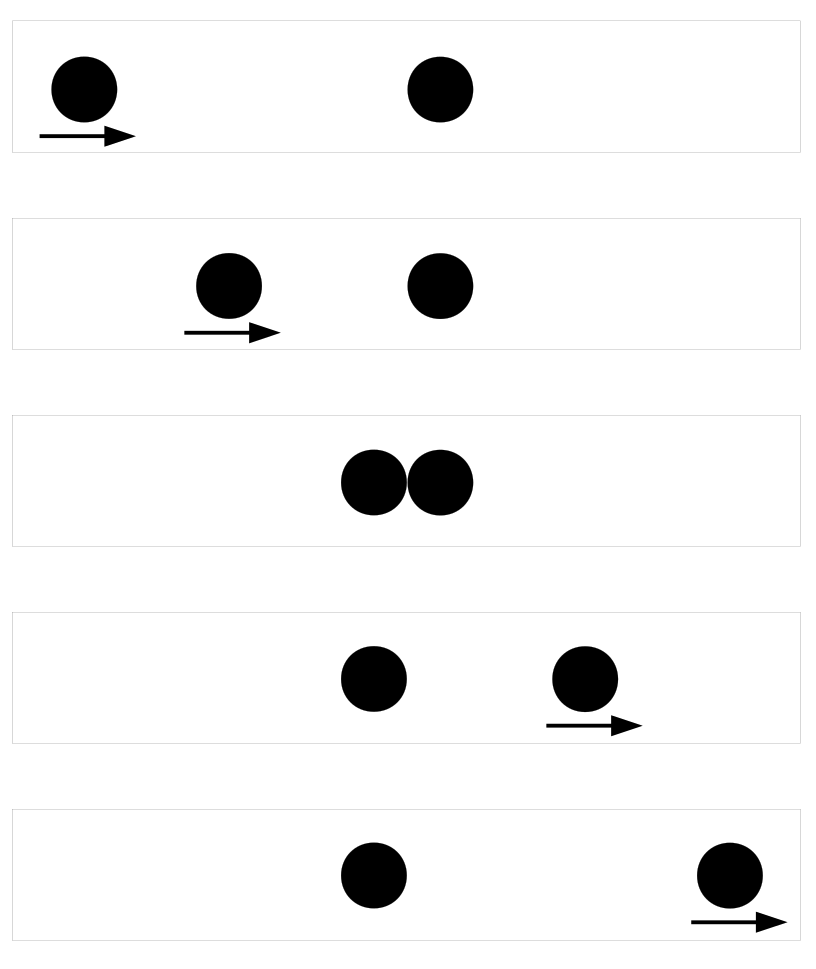
Michotte’s famous experiments employed projected displays of moving discs and rectangles to instantiate certain rudimentary types of motion and interaction. A representative example of a ‘launching effect,’ in which one moving disc is observed to transmit its energy to a second, is depicted in the figure above. By systematically varying the speeds of the objects, the distances between them, and the directions of their motion, the subjective perception of causality was linked to simple quantifiable features of the visual displays. Based on his results, Michotte theorized that the visual perception of causality depends on three factors: the spatial proximity of the participating objects, the temporal coincidence of cause and effect, and a correspondence of ‘form and matter’ between the effect and the cause.
Although his experimental techniques were oriented toward abstract iconic shapes and simple causal percepts, Michotte was well aware that certain simple types of motion could induce the impression of animacy. Says Michotte,
Among the examples of causality mentioned, … several, it will have been noticed, were concerned with human activity. This is no accident. Situations in which mechanical causality can actually be perceived in the world of inanimate nature are in fact very rare (except in the case of machines made by man) …
Besides their relations with external objects, the movements made by a man or an animal possess a special character which, in the normal way, differentiates them clearly from the movements of inanimate objects, and makes it easy to recognise the presence of animal life, an important fact from the biological point of view. These movements are not only spontaneous, like those of inert objects which begin to move without external cause, but they also have the appearance of being activities of which the object itself seems to be the source. Thus when observers describe what they see in simple language, they say without exception that they see an object which is ‘moving of its own accord’, or ‘is going under its own steam’ (Michotte, 1963, p. 184).
Thus inspired, Michotte conducted several foundational studies of visual animacy cues, using geometric shapes that specifically suggested locomotion. One display in particular featured a rectangle that mimicked a caterpillar inching its way across the screen. Subjects who were shown motion of this type voluntarily would exclaim ‘Caterpillar!’ or ‘Worm!’ in instant recognition, even though the rectangle itself had no other outward resemblance to a living creature.
One final insight of Michotte’s is worth noting. After having observed innumerable reactions to these visual displays, it seemed that notions of causal motion could also be linked to emotions. Many colloquial phrases, such as ‘It shook me to pieces’, ‘It got me down’, or ‘It knocked me flat’ provide a crucial connection. “All these terms not only have a kinematic significance; in addition they clearly imply mechanical action” (Michotte, 1963, p. 283). To Michotte, these linguistic idioms implied cognitive processes about emotional states that make direct and consistent use of kinetic and spatial imagery. In making this observation, Michotte preceded Lakoff and Johnson’s (1980) contribution to cognitive linguistics by some thirty-five years.
Apparent Social Emotion in Geometric Shapes
Michotte was primarily concerned with the immediate phenomenological experience of causality, but research in this tradition continued to investigate more complex perceptual impressions. Around the same time as the publication of La perception de la causalité, Austrian psychologist Fritz Heider and his student Marianne Simmel were investigating the perception of social emotion at Smith College in Massachusetts. In a landmark study, Heider and Simmel (1944) demonstrated that simple geometric shapes can spontaneously be perceived as animate, social agents with goals and feeling states. A film depicting moving geometric shapes was shown to several participants. In this film, depicted in the figure below, a triangle and two circles move within and around a crude ‘enclosure,’ pantomiming a dramatic narrative. Viewers spontaneously described the scene using not only basic emotion words like ‘happy’ or ‘afraid,’ but also reported observing more complex socially-tinged affective states such as frustration, rage, hesitation, love, and vengeance.
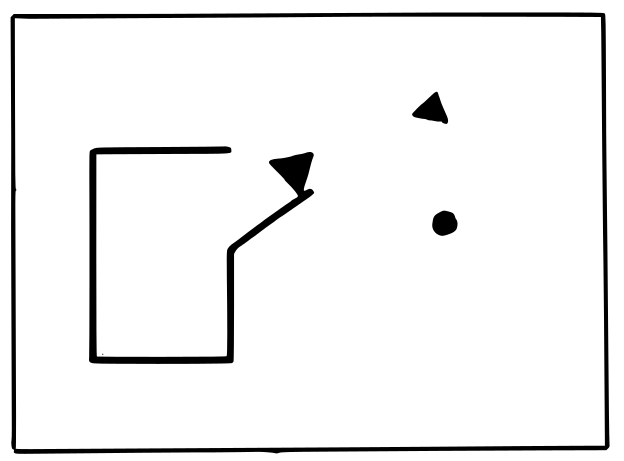
What is more, participants in the study volunteered this sort of description whether they had been told that the shapes represented people or not—the study participants had spontaneously inferred from some properties of the display that they represented living things, and proceeded to describe the events in emotional terms. Several years later, it was found that participants would use the same emotional descriptions even when they were specifically admonished to describe the scene in geometric terms only (Hashimoto, 1966). The motion of the shapes, it seems, was simply too compellingly lifelike for sterile geometric descriptions to suffice.
Because geometric shapes such as Heider and Simmel’s lack outward morphological resemblance to living creatures, it seems that their motion and interactions must have cued viewers to perceive them as being animate. At least two characteristics of animate beings might have been directly perceived. First, the shapes might have appeared to locomote under their own power. Second, the shapes might have appeared to intentionally pursue certain goals, based on their trajectories. Although the study participants might have inferred sentience, intelligence, or even meta-cognition, it seems unlikely that these could have been directly perceived from shapes moving on a screen. Presumably, these higher-level characteristics of animate creatures might have been inferred from the shapes’ apparent locomotion or intention.
The excitement surrounding the idea that simple moving shapes can suggest emotional states might seem somewhat perplexing to musicians and music lovers, whose art has long used ‘simple’ vibrations in the air to express emotions or to construct dramatic scenes. Nonetheless, Heider and Simmel’s results raise the question of why these sorts of descriptions are so naturally attached to musical sounds in the first place. One wonders whether a similar experiment using minimal musical stimuli would produce analogous results, and perhaps suggest what low-level feature might be triggering animate descriptions of music.
Perceptual Animacy and the Energy Violation Hypothesis
A comprehensive theoretically-driven study of perceptual animacy was provided by Judith Ann Stewart in her (1982) dissertation. Stewart observed that one characteristic feature of animals is the ability to initiate changes in movement using stored chemical energy. Because animate objects have internal sources of energy, Stewart conjectured that objects which appear to respond to unseen forces should appear to be animate. This hypothesis could be called an ‘energy violation’ hypothesis of animacy cues (Scholl & Tremoulet, 2000).

Using several displays depicting the motion of a single dot (as in the figure above), Stewart investigated whether apparently self-initiated changes of direction and velocity would increase the likelihood the dot would appear alive. For example, if a dot appears to bounce off a flat barrier, its change in acceleration could be easily attributed to the barrier’s presence. However, an identical display with the barrier removed ought to leave the viewer wondering what might have been the source of the dot’s change in direction. For the most part, Stewart’s predictions turned out to be correct, with direction-changing acceleration strongly predicting the perception of animacy. Subsequent experiments using minimal visual stimuli have replicated and extended these findings (Gelman, Durgin, & Kaufman, 1995; Tremoulet & Feldman, 2000), making the energy violation hypothesis of animacy cues quite compelling.
Because the visual displays used by Michotte, Heider and Simmel, and Stewart all depend on the motion of onscreen shapes, they implicitly provide evidence only for locomotive animacy cues. However, one could easily argue that an energy violation hypothesis would apply equally well to other characteristics of animacy.4 Communication by its nature relies on channeling energy into visual, acoustic, chemical, or electric signals. Moreover, biological minds that have sentience, intelligence, self-consciousness or metacognitive capacities all exhibit a form of anti-entropic organization that requires the continual investment of energy—brains require a constant supply of chemical fuel to operate, and in humans the brain consumes more energy than any other organ.
Because animacy connotes so many different possible capacities, perceptual animacy might not be as simple as a binary distinction. Instead, it might represent an entire class of different perceptual cues operating simultaneously. It has even been proposed that movements such as those appearing in Heider and Simmel’s display might be directly perceived as chasing, evading, courting, being courted, fighting, or playing (Blythe, Todd, & Miller, 1999). Each of these scenarios in turn could represent many of the aforementioned characteristics of animacy, including locomotion, communication, intelligence, or even presence of self-conscious emotions like love. As research in this area continues, an important question to resolve will be the degree to which these percepts rely on higher-level cognitive processes, and how much they are attributable to lower-level perceptual features.
Animacy in the Auditory Sense
If the perception of an apparent energy source is crucial for the visual perception of animacy, then one might think that the auditory system, itself a non-trivial energy detector, would be particularly attuned to the animacy of sound sources. However, few have yet investigated the existence of auditory animacy cues (Scholl & Tremoulet, 2000). As an initial step, several possible cues will here be suggested.
Auditory and visual perception are completely different modalities with different psychophysics. While visual experiments have dealt mainly with locomotive animacy cues, auditory perception might be better attuned to other features of animate things altogether. The characteristics of animacy already enumerated—locomotion, intentionality, communication, sentience, intelligence, and self-consciousness—will be used to generate several hypotheses. Future work might later reveal whether these cues produce mandatory, immediate animacy percepts.
Locomotion. Animals produce a wide variety of sounds when they move, including footsteps, tapping, scratching, breaking, knocking, brushing, and rubbing. Several organisms produce distinctly recognizable periodic sounds by their movements, such as a horse that trots or gallops. Other animals produce irregular noises such as rustles and crackles as they move through foliage. In both of these cases, sustained motion would produce sounds that do not become softer over time, which could provide perceptual evidence that there is a driving source of energy. In the case of music, there are many obvious correspondences with physical motion, especially with regard to speed, investigated in Chapter 5.
Intentionality. Intentionality could be described as the possession of goal directed mental states. In order for intentionality to be perceived, however, it must first be translated into some observable action by a creature exercising volition. One form of volitional action could be the goal-directed motion employed by (Stewart, 1982). However, a simpler volitional exercise might be in the form of making a simple binary choice, akin to flipping a power switch on or off. That is, sounds that suddenly start, stop, or resume might indicate that the sound source chose to move in such a way, and is therefore animate.
Imagine the stalking behavior of a house cat hunting a field mouse. In order not to alarm its prey, the cat will not simply dash toward its target as soon as the mouse can be seen, because the probability of a successful strike from a distance is low. Instead, it would benefit the cat to strike from nearby. In order to reach such a position, the cat will divide its approach into several stealthy movements, interspersed with periods of stillness. This discontinuous behavior, which could also result in discontinuous sounds, would reflect volitional modulation of an internal energy source.
Communication. Animate things often produce communicative signals, both to coordinate behavior with allies and to issue warnings to enemies. One common signalling modality is vocal communication, which constitutes a suite of readily identifiable sounds produced by passing air over a vibrating membrane. Because only animate things can communicate vocally, sounds resembling vocal noises in pitch and timbre might well serve as animacy cues, as will be explored in the next chapter.
Another type of acoustic communication makes use of percussive sounds, such as a rattlesnake’s warning rattle or a gorilla’s chest thumping. If these sounds start and stop suddenly, they might suggest volition, and if they maintain their volume (or even get louder), they would suggest the continual investment of energy. If these percussive sounds are organized into distinctive patterns that could not be easily generated by naturally-occurring pendular motion, this could provide additional evidence that a willful agent might have produced them. Hence, many types of percussive sound—not only those representing locomotion—could potentially serve as animacy cues.
Note that both vocal and percussive communication sounds exhibit periodicity resulting from the investment of energy, corresponding to a sort of non-randomness or decreased entropy. Thus, the simple presence of periodicity in general could suggest a concentrated source of energy available for work, and therefore an animate presence.
Sentience. A sentient being can experience sensations, emotions, and affective states. In the auditory modality, this could be perceived in terms of the pitch, loudness, and contour of vocalizations. It has often been suggested that music can appear to express emotions by merit of resemblance to vocal prosody (Kivy, 1980; Juslin & Laukka, 2003; Ilie & Thompson, 2006). In order to account for systematic regularities in both musical and vocal expressivity, an ‘ethological model’ of musical emotion has recently been proposed (Huron, 2012).
One might expect that in order to interpret prosodic cues, it would first be necessary to identify a sound as vocal in origin. On the other hand, perhaps the vocal origin and affective content of a sound could be simultaneously recognized. As German musicologist Viktor Zuckerkandl (1956, p. 60) has noted, “tone sensations… are always colored by feeling. We do not hear flute tones or trombone tones; we hear charming flute tones, solemn or threatening trombone tones. Low tones sound serious, high tones gay, and so on.”
Intelligence. Another promising way in which listeners might infer animacy is by detecting evidence of intelligence. One way this could occur is if meaningful syntactic patterns could be identified in an auditory percept. The presence of a coded message would strongly imply the existence of an animate agent using a language. Indeed, ‘intelligent’ is an adjective often applied in musical description, and several pieces of music could be described as ‘cerebral’ by merit of the complex relational patterns they exhibit.
While human language is an obvious place where syntactic sounds can be found in nature, it should be noted that syntactic sounds can be found in other places as well. For example, whales and songbirds have been observed to make grammatical sounds that are learned through experience. Whether or not these sounds reflect ‘intelligence’ as usually understood is unclear, but it is indisputable that whales and songbirds are at least alive.
Self-consciousness. Directly perceiving self-consciousness through sound would seem rather unlikely. However, it remains possible that sound sources could be imputed to have metacognitive states if they were to exhibit sufficient animacy cues of other sorts. Indeed, the shapes in Heider and Simmel’s display might have seemed to some participants to exhibit complex social emotions such as love, shame, or jealousy, which would depend on metacognitive capacities. Relationships between musical elements and social emotions are directly investigated in Chapter 4.

While auditory animacy cues remain little studied from a psychological perspective, there would seem to be ample anecdotal evidence that they might exist. A more thorough investigation of auditory animacy might reveal much about how we interact with all aspects of our auditory environment, musical and nonmusical alike.
Animate Musical Lines
When we listen to music, there are innumerable things to which we can pay attention, including melodies, basslines, rhythms, harmony, texture, and timbre. In part, the multidimensional complexity of music is what makes it possible for one composition to provide several different unique listening experiences. One could focus on a piece’s bassline, attempt to pick out motivic transformations, follow harmonic functions, or simply let timbres guide the ear. There are as many possible ways to listen to a Webern string quartet as there are segmentational analyses of the surface, a very large number indeed. If, as philosopher Charles Nussbaum has suggested, “the acousmatic realm of the composer is an animistic realm” (Nussbaum, 2007, emphasis in original), we might then inquire which aspect of a musical surface is animated. Is it that the entire surface sounds lifelike, or is it that individual entities or agents within the music sound alive?
Many music theorists are familiar with Heinrich Schenker’s penchant for organicist analogy and animism (Solie, 1980; Pastille, 1984; Hubbs, 1991). At least two musical elements were described in animate terms by Schenker over the course of his career: individual tones, and entire motifs.5 In Harmony, Schenker compares motives directly to biological creatures, complete with reproductive urges (Schenker, 1909/1954).
Man repeats himself in man; tree in tree. In other words, any creature repeats itself in its own kind, and only in its own kind; and by this repetition the concept “man” or the concept “tree” is formed. Thus a series of tones becomes an individual in the world of music only by repeating itself in its own kind; and, as in nature in general, so music manifests a procreative urge, which initiates this process of repetition… We should get accustomed to seeing tones as creatures. We should learn to assume in them biological urges as they characterize living beings (p. 6).
Later Schenkerian thought centered around the Tonraum, a world of pitches in which tones themselves were animate agents. To Schenker, these tones seemed to have intentionality—Tonwille—and the most sensitive composers could help the tones realize their urges, both to generate octaves, fifths, and thirds and to find their ultimate consummation in the descent of the Urlinie.
In order to understand why Schenker might have chosen to animate tones and lines instead of rhythm, harmony, meter, or loudness, it is useful to consider how a musical surface is perceived. A fundamental process of music perception is akin to a score segmentation problem in the analysis of atonal music, in which vertical and horizontal units are discretized based on various structural, functional, or acoustic dimensions. The perceptual segmentation process is an important component of a more general capacity of the auditory system, known as auditory scene analysis (Bregman, 1990). Through this process, raw acoustic vibrations are transformed into a coherent ‘auditory image’ of one’s surroundings, with sounds apparently emanating from the same source grouped into perceptual units, or auditory objects.
The process of scene analysis allows us to perceptually link together discrete musical sounds into larger streams of sounds: melodies (Dowling, 1968). Using acoustic aspects of sound such as pitch proximity and temporal spacing, the auditory system automatically identifies which sequential sounds were likely to come from the same source, in a process known as stream segregation. We have some volitional control over our percepts as well: we can choose to follow the melody line, the bass part, or inner voices of a chorale in a way similar to how one can tune into one speaker at a time at a cocktail party.
When perceiving animate agents in the auditory environment, it seems clear enough that the sound source itself is the thing that is animate, not the entire scene. As the preeminent instances of auditory streams in music, melodies provide the best targets for the possibility of animacy. This is consistent with common experience as well; it would seem to be nearly impossible to listen to music without hearing any lines at all. Lines are of utmost importance to Schenker as well: “Every linear progression shows the eternal shape of life—birth to death. The progression begins, lives its own existence in the passing tones, ceases when it has reached its goal—all as organic as life itself” (Solie, 1980).
Melodies have often been described as being alive, beautiful, and expressive. The opening quotation by critic E. T. A. Hoffmann directly compares Beethoven’s motives—themselves linear melodies—to living creatures. Philosopher Georg W. F. Hegel claimed that melody, in contrast to meter, rhythm, and harmony, is the “free-sounding soul in music” (Schnädelbach, 2010, p. 84). Hegel is of course not alone; for example, the German aesthetician Eduard Hanslick (1891/1986) claimed in his famous monograph on musical aesthetics, “Unconsumed and inexhaustible, melody holds sway over all, as the basic form of musical beauty” (p. 28).
As music theorist Fred Maus (1992) has pointed out, Hanslick was prone to describe music as though one or more interacting people are in the room, despite his avowed formalist stance.6 This would seem to closely align with the drama that unfolded in Heider and Simmel’s (1944) display: Participants in their experiment did not describe the entire scene, but rather the shapes within the scene. In the case of music, it seems possible that listeners hear each musical line as an individual animate agent.
Conclusion
We have proposed that animate descriptions of music are not merely literary anthropomorphisms, but instead reflect a fundamental mode of perception that distinguishes the animate from the inanimate. Underlying this process are perceptual animacy cues that reflect characteristics such as intentionality, sentience, or intelligence. For something to be animate, it must have some internal energy source that fuels its mind and movement, whether this leads to locomotion, periodic sounds, or the production of organized patterns. Because musical lines are more readily perceivable as sound sources than other aspects of a musical surface, melodies and motives are more likely to be perceived as animate agents than, for instance, harmonies, textures, or formal structure.
Although the present account adopts a modern scientific perspective, we have in fact resurrected a very old idea. Long ago, the Aristotelian Problemata discussed music’s moral or ethical character, ethos (ἦθος) (Problems XIX, Problems Connected with Harmonia). The twenty-seventh problem reads as follows:
Why does what is heard, alone of perceptible objects, possess ethical character [ἦθος]? Indeed, even if a melody is without words, it nonetheless possesses ethical character; but neither color nor smell nor flavor possess it. Is it because (what is heard) alone possesses movement, though not that which the sound moves in us? For such movement exists in the other (perceptible objects) too—indeed, even color moves our sight; but we perceive a movement that follows this sort of sound. This movement has a likeness (to ethical character) both in the rhythms and in the arrangement of high and low notes, not in their mixture. But consonance [συμφωνία] has no ethical character. This character, however, does not exist in the other perceptible objects. But these movements are connected with action, and actions are signs of ethical character. (Aristotle, Problems XIX.27)7
In the words of Classics scholar Andrew Barker (1984), this problem’s author observed that “Moral character is represented by movement from note to note, not by notes played simultaneously” (p. 197). Perhaps the auditory perception of animacy cues attached to musical lines could explain why the Greeks heard ethical melodies, why neither the Harmonicists nor Rameau was ever completely able to unseat melody as the heart of the musically beautiful, and why Schenker elevated melody to the pinnacle of his theory of musical organicism.
The presence of animacy cues in music would suggest that it ought to demand a particular sort of attention that inanimate, static percepts would not. However, this does not explain why music should be as uniquely captivating as it often seems to be; mere animacy must not be enough. After all, we tend not to become completely entranced by each and every one of the many animate agents we encounter each day. It is also easy to find decidedly nonmusical things that seem to exhibit animacy cues: even if a fire alarm is perceived animately because of its voicelike timbre, it would still seem unlikely to enchant many ears. Evidently, simple animacy cues are not quite enough to make music.
One possible missing component is whether or not a listener is deliberately paying aesthetic attention. As John Cage has vividly demonstrated, music—or at least aesthetic auditory experience—can be found in a broad range of sounds. It is possible that all that is missing to make an animate sound musical is the appropriate aesthetic mindset, as avant-garde composers have often reasoned. Consider as an example Arseny Avraamov’s Symphony of Sirens, which debuted in 1922 in Baku, Azerbaijan. The piece combined a bewildering array of modern industrial and military sounds, including heavy artillery and factory sirens (Wendela, 2012). Undoubtedly this performance captured the attention of those who were nearby to witness it. However, it is unclear whether it would invite willful attention, repeat performances, or humming along in the same way a traditional orchestral symphony or hit single can.
While Avraamov’s Symphony of Sirens is a human product that exploits certain biological tendencies for artistic purposes, it seems not to be a ritualization of them. One must conclude that not all apparently animate sounds closely resemble the sort of thing that usually results from human culture. Not only must there be a sense of animacy, it would seem that there must be a certain sense of humaneness: although music is a Queen of Heaven, a siren is a shrieking demon, alive but inhuman.

That is, a prey animal should be more likely to mistake wind-rustled leaves for a predator than a predator for wind-rustled leaves. ↩
Philosophical treatments of this problem can be found in Kivy (1980) and Davies (1994). ↩
These ideas are by no means uncontroversial. See, for instance, Fauconnier (1999). ↩
Realizing this, Stewart (1982) also conducted explicit tests for perceptual intentionality by manipulating whether ‘goal objects’ were present in some displays. However, this inference would also depend on observing directed locomotion. ↩
In its later stages, Schenker’s theory of musical organicism eschewed the notion of motive in favor of a synchronic, multi-layered outgrowth from a fundamental structure (see Schenker, 1935/1979, §50, §254, §308). ↩
Perceptual systems conceived in the Gibsonian sense are unlikely to operate in a formalistic way, despite the protests of their possessors. For his part, Hanslick clarified that such animate descriptions were to be understood metaphorically only. ↩
Parenthetical expressions are the translator’s; square brackets enclose the original Greek. ↩