Chapter 5
Musical Line Mediates Musical Pitch-Speed Relationships
Abstract
We conducted four tests of the conjecture that higher musical pitch coincides with faster musical speeds in composition and performance. First, a “notewise” examination of western musical scores tested whether longer (i.e., slower) notes tend to have lower pitches. Results were genre-dependent, with three of six sampled styles exhibiting the predicted effect. A second study considered an independent sample of Western music part-by-part and found that lower musical voices tend to have significantly fewer notes than higher voices. The third study used instrumental recordings to directly measure event onset densities in notes per second. A strong correlation (rs = 0.736, p < .002) between performed note speed and an instrument’s pitch range (tessitura) was found. Finally, a fourth study indicated that Baroque ornaments are more likely to appear in higher musical parts. Considered together, these four studies suggest a pitch-speed relationship that is most evident when the methodology preserves the notion of musical “line.” We outline several possible origins for the observed effect.
Introduction
To a musician or lover of music, the idea that lower voices in western music move at slower rates than higher voices might seem intuitively obvious. Some of the most memorable musical passages are virtuosic coloratura arias or dazzling violin cadenzas, both of which typically feature rapid passagework in a high pitch range. Similarly, some of the most dramatic music written in lower pitch ranges is relatively slow, as is the case for funeral marches or laments. Nonetheless, it is possible that this supposed pitch-speed relationship does not accurately reflect compositional and performance practice, and instead reflects cognitive or perceptual biases.
Musical dimensions such as pitch and speed exhibit perceptual interaction effects, in which a change in one dimension can influence the perception of another (see, e.g., Prince, 2009). Specifically, Collier and Hubbard (2001) found that listener perception of the speed of isochronous stimuli is affected by pitch height and contour in addition to tempo: higher-pitched tone sequences were perceived as being faster than lower-pitched tone sequences. Boltz (2011) recently replicated and extended these findings, again using isochronous pitch sequences. Melodies of higher pitch and brighter timbre were judged to be faster than comparison melodies of the same nominal tempo. Presuming that perceptual pitch-speed interactions apply to typical listening situations, one would predict that higher-register music will generally sound faster than it truly is. Consequently, the intuition that higher music tends to be faster might be partially or even entirely illusory. The primary purpose of the present investigation is to empirically test whether higher music truly does tend to be faster.
To explain the observed perceptual effects, Boltz (2011) proposed that perceptual interactions might derive from regularities in one’s auditory environment. The reasoning is thus: if high pitches and fast speeds tend to coincide, then information about one dimension could provide useful information about the likely state of the other. Therefore, our test for an objective pitch-speed relationship in music carries implications regarding the origin of the perceptual interaction itself.
We conducted four separate studies testing the hypothesis that fast musical speeds tend to coincide with high musical pitch in western composition and performance practice. Because the notion of musical speed does not precisely correspond to a single obvious measurement technique, we applied four complementary methods, hoping to provide a more complete account of pitch-speed effects in musical organization.
Measuring Musical Speed
Measuring musical speed in practice poses challenges not faced in controlled experimental conditions. Stimuli from experiments are often isochronous sequences of notes, whose speed is straightforward to measure as onset densities (i.e., notes per second) or interonset intervals (IOIs) (Collier & Hubbard, 2001; Boltz, 2011). In short, the speed of isochronous sequences can simply be treated as identical to the music’s tempo, yielding a measure of speed which is both intuitive and practical.
However, most western musical compositions do not consist solely of monophonic sequences of isochronous notes. Instead, music is typically polyphonic: pieces include multiple sounding notes at once, organized into melodies, harmonies, basslines, and accompaniment patterns. Additionally, most western rhythmic schemes are considerably more complex than simple isochrony: note onsets and durations are usually specified in terms of a note’s position in a hierarchic metric framework. An underlying pulse (the tactus) is subdivided into several metric levels, and musical rhythms are specified relative to the prevailing meter. In western music, “tempo” is understood not as a characteristic of notes and melodies, but as a description of the meter’s tactus.
The distinction between meter and rhythm helps explain why tempo alone cannot account for all types of musical speed. For example, statements such as “the violin is playing much faster than the cello in this piece” must depend on factors apart from tempo, since both parts would be playing within the same meter. This suggests that many possible forms of perceptual musical speed could be recognized, potentially with contributions from metric structure, tempo, rhythms (Kuhn, 1987), articulation (Geringer & Madsen, 2006), or even distances in “pitch space” (cf. Boltz, 1998). Hence, one might expect that a definitive study of musical speed would depend on a nuanced model of what exactly is meant by fast and slow musical speeds. Because no such model has yet been widely accepted, the present research employs multiple different operational definitions of “musical speed” in order to test the hypothesis that western compositions exhibit pitch-speed relationships.
In order to motivate possible indices of musical speed, we will briefly discuss a musical example: John Philip Sousa’s march, Stars and Stripes Forever. The Grandioso section of this turn-of-the-century march contains a fast-paced obbligato part which is assigned to a piccolo player (Figure 1). The tuba part, by contrast, plays the “oom” of a typical “oom-pah” march pattern. Here, the piccolo and tuba parts appear to be moving at different speeds, despite being played at the same tempo.
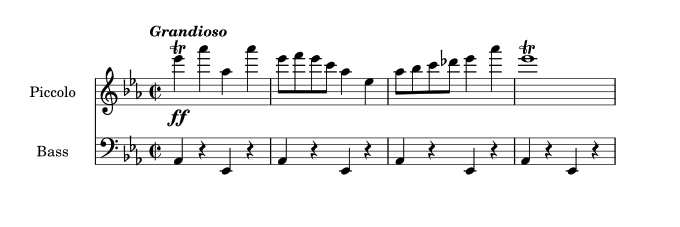
The apparent cooccurrence of fast and slow speeds in this piece suggests several musical features apart from tempo that might contribute to musical speed. At least three easily-measurable factors are apparent. First, the average notated duration in the faster piccolo part is somewhat shorter than in the slower tuba part. Second, the piccolo part plays more notes than the tuba part: seventeen versus the tuba’s eight. Third, the piccolo contains two trills: melodic ornaments that specify rapid alternation between two pitches.1 These three temporal and rhythmic features—note length, note count, and ornaments—might all be useful when measuring musical speed. Specifically, these features appear to relate to either melodic speed (the amount of “musical motion” present in a certain melodic line) or musical activity (how active the music seems to be). In the following, we employ all three features as indices of musical speed.
One additional methodological challenge remains: the question of how to interpret notated durations, which specify metric time internal to the piece instead of clock-time. While some compositions include tempo indications in beats per minute, others give only imprecise written instruction such as “Adagio,” or omit tempo markings altogether. There are other complications as well: compositions might change tempi several times, and performers often are free to employ expressive timing deviations such as rubato, accelerando, and ritardando, whether or not they are expressly indicated. Interpreting notated durations therefore presents a potential methodological pitfall: even in the optimal case that two pieces have identical tempo markings, the length of a notated quarter note in one composition might still differ from a notated quarter note in the other. Fortunately, one can minimize the problem of tempo mismatches by making duration comparisons only within an individual musical work, and not between multiple pieces. Furthermore, one could seek converging evidence from sources other than musical scores, such as performance recordings. In the following four studies, both strategies are applied.
The first study measures melodic speed using note duration, where short durations would be associated with fast melodic speeds, and vice versa. Because each note is considered individually in terms of its pitch height and its duration, we could call this a “notewise” approach. Pitch-duration correlations were calculated to measure pitch-speed relationships independent of musical part or instrument. Inspired by the fact that music tends to be organized into individual “parts” or “voices,” a second study employs note counts to measure musical “activity,” predicting that higher musical parts would contain more notes. We consider this to be a “partwise” approach to measuring musical speed. Study 3 measured musical speeds in notes per second from recordings, testing for instrument effects on likely performance speeds. Musical speeds were correlated with an index of instrumental tessitura: the instrument’s typical range of sounding pitches. Finally, a fourth study tested whether melodic ornaments in Baroque keyboard music tend to occur in higher musical voices.
To anticipate our results, we will report empirical evidence consistent with a pitch-speed relationship in composition and performance, in which higher music does indeed tend to be faster. Furthermore, it seems that this relationship is most evident when the experimental method preserves the notion of musical “line.”
Study 1: Notewise Relationship Between Pitch Height and Duration
Methods
If there is a relationship between pitch height and musical speed, then one might predict that high-pitched notes should typically exhibit shorter durations than low-pitched notes, regardless of instrument or musical part. To test this hypothesis, we queried six existing databases of notated western art music, representing contrasting styles and periods. Specifically, our convenience sample included 34 assorted vocal motets by English composers Leonel Power (c. 1370–1445), John Dunstable (c. 1390–1453), and Thomas Morley (1557–1602), 21 movements from the Brandenburg concertos by Johann Sebastian Bach (1685–1750), 24 movements from orchestral symphonies 99–104 by Franz Joseph Haydn (1732–1809), 15 movements from the first, third, fifth, and seventh symphonies by Ludwig van Beethoven (1770–1827), 24 piano preludes by Frédéric Chopin (1810–1849), and 44 piano rags by Scott Joplin (1867–1917). These works span nearly six hundred years of musical history, but were not chosen to be a stratified sample representative of all western music. We therefore analyzed each subsample individually.
For a given score, each note was characterized according to its pitch distance in semitones from middle C (C4) and its notated duration (measured in quarter durations). For example, a half note G4 would be coded as having the pitch +7 and duration 2.0. Any transposed orchestra parts were restored to their actual sounding pitch before processing, and piano sustain pedal markings were appropriately expanded. Examples of this pitch-duration representation are shown in Figure 2.
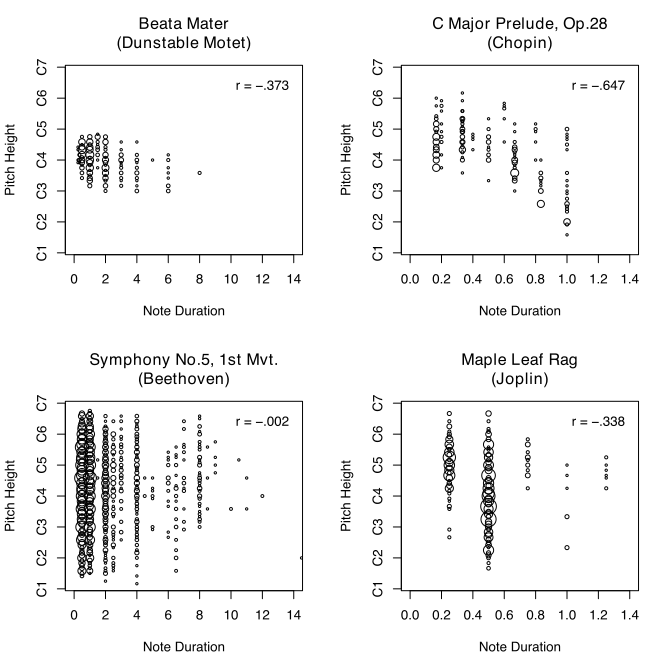
To determine whether long notes tend to be low-pitched, we calculated the sample correlation r between pitch height and note duration for each individual score, providing a measure of their linear relationship. Positive (+) pitch-duration correlations indicate that long durations are associated with higher pitches. By contrast, the hypothesized pitch-speed relationship predicts that long durations (i.e., slower music) would be associated with lower pitches. Therefore, negative (−) correlations would be consistent with the pitch-speed hypothesis. To address the aforementioned tempo problem of score-based studies, we made only intra-opus comparisons of pitch and duration, computing a separate correlation for each individual piece.
Statistical inference was carried out on the correlations via binomial sign tests. Although composers might indicate explicit tempo and meter changes within a given work, statistical inference based on this test should not be affected, provided the marginal distribution of pitches does not change and the direction and location of tempo changes is not systematically biased.
Results
| Sample | Pieces (Total Notes) | Mean | (+) | (−) | Binomial p |
|---|---|---|---|---|---|
| English Motets | 34 motets (28,013 notes) | −0.172 | 2 | 32 | p < .0001 ** |
| Bach Concertos | 21 mvts. (103,780 notes) | −0.093 | 4 | 17 | p = .004 * |
| Haydn Symph. | 24 mvts. (157,808 notes) | −0.003 | 12 | 12 | p = .58 |
| Beethoven Symph. | 14 mvts. (169,576 notes) | 0.021 | 10 | 4 | p = .97 |
| Chopin Preludes | 24 preludes (18,871 notes) | −0.059 | 11 | 13 | p = .72 |
| Joplin Rags | 44 rags (64,915 notes) | −0.105 | 8 | 36 | p < .0001 ** |
Counts of positive and negative correlations between pitch height and note duration, calculated note by note for individual pieces of music. The average correlation across all works in a given corpus is provided as a summary statistic, using the Fisher z-transform (see Silver & Dunlap, 1987). If higher notes tend to be faster (i.e., shorter), one would expect more negative correlations than positive correlations to appear. The number of pieces exhibiting positive and negative correlations in each corpus are given, along with one-tailed p-values based on the binomial sign test. Starred (*) p-values indicate statistical significance (adjusted α < .008); double-stars (**) indicate stronger evidence (p < .0001).
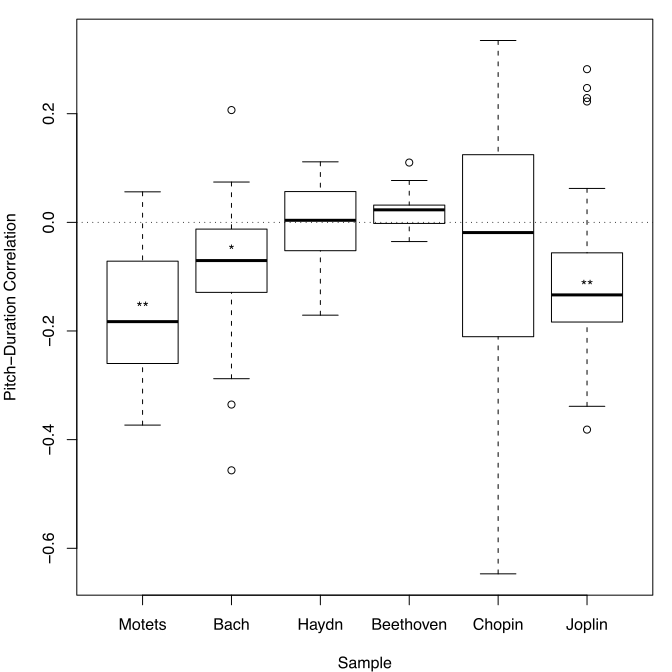
Figure 3 depicts the distribution of notewise pitch-duration correlations for each subsample. While the English motets, Bach concertos, and Joplin rags tend to show negative correlations between pitch height and note duration, the Haydn symphonies, Beethoven symphonies, and Chopin piano preludes do not. There are some distributional differences between the subsamples as well: the Chopin preludes in particular exhibit a much broader range of possible correlations.
Table 1 summarizes the correlations between a notated pitch height and duration for compositions in all six musical subsamples. For each genre, the number of works exhibiting positive and negative correlations is tabulated, where negative correlations are consistent with the hypothesis that higher notes tend to be shorter. A rough indication of the strength of the association within each sample is provided by an average correlation.2 Every subsample except the Beethoven symphonies skews in the predicted direction.
One-sided Fisher sign tests were accordingly applied to each corpus’ pitch-duration correlations. Using the Bonferroni correction for multiple tests, p-values below α = .05/6 = .008 were considered statistically significant. By this criterion, we conclude that English motets (B(34) = 32, p < .0001), Bach concertos (B(21) = 17, p = .004), and Joplin rags (B(44) = 36, p < .0001) tend to have longer notes at low pitch and higher notes at high pitch, consistent with the pitch-speed hypothesis. However, the results for the Haydn symphonies, Beethoven symphonies, and Chopin preludes are statistically nonsignificant.3
Discussion
Based on the observed correlations between pitch height and note duration, it appears that certain types of music do indeed exhibit faster “notewise” speeds in higher pitch registers in the sense that higher notes tend to be shorter. Nonetheless, this notewise pitch-speed relationship does not seem to generalize across all musical styles and composers. In the case of the symphonies and piano preludes, other (perhaps culturally-derived) compositional determinants might exert more powerful organizational effects.
On the other hand, extant pitch-speed relationships might have been obscured by one or more confounds, such as expressive timing deviations, tempo changes, or instrumentation effects. Notably, the strongest pitch-speed relationships were found in vocal motets and piano rags, two styles characterized by having short length, steady tempos, little expressive modification by performers, and uniform instrumentation. By contrast, symphonies and concertos tend to be longer pieces punctuated by many different textures involving several instrument types. Moreover, the works of Chopin are commonly associated with the use of tempo rubato, making accurate interpretation of notated durations especially difficult. Although these score-based results are compelling, additional studies of actual performances could provide a more complete understanding of notewise relationships between pitch and duration.
It could also be argued that the correlations used here cannot adequately capture all types of perceptible musical pitch-speed relationships. Perhaps note duration alone cannot always measure musical or melodic speed without additional contributions from inter-note pitch intervals or time intervals. In other words, musical speed might emerge primarily when successive tones are understood as comprising musical “lines.” If this is true, then a sufficiently sensitive measurement of speed would require integration across multiple notes. To explore this possibility, our second study tests for the presence of the hypothesized pitch-speed relationship insofar as it is mediated though musical organization into parts.
Study 2: Partwise Distribution of Musical Activity
In western music, it is common to organize music according to musical “parts” or “voices.” These are typically distinguished by the person, instrument, or group of instruments performing the part. For example, a choral work might have four separate musical parts—soprano, alto, tenor, and bass—and each would be performed by a different group of musicians. Musical parts can also be understood in a more general sense as being distinct melodies occupying a certain region in pitch space. In this way, music written for a polyphonic instrument such as the organ might also be organized into parts, despite there being only a single performer. It is possible that pitch-speed relationships in musical practice arise and are perceived according to such partwise organization. In order to test for a partwise pitch-speed correspondence in compositions, we formulated a second testable prediction: if compositions tend to be organized such that higher music is faster, then one would predict that higher musical parts should contain more notes than lower musical parts—that is, higher parts should be more “active” than lower parts.
Measurements of the effect of musical part per se might be easily confounded by instrumental effects. In a given ensemble, it is common for particular instruments to carry certain musical parts. For instance, in a woodwind quintet, the bass is generally assigned to the bassoon, with the treble voices assigned to the flute and/or oboe. Different instruments tend to exhibit different acoustic and mechanical properties, possibly affecting the general speed with which an instrument can be played. For example, one might expect that a valve trombone can be played faster than a slide trombone. It is therefore possible that any observed differences in speed across parts might actually arise from properties of an instrument rather than of the musical part’s position in the texture. In order to minimize instrumental confounds, we sampled only those musical works which employ similar instruments on all voices or parts.
Using a previously-encoded database, we selected three groups of suitable scores based on the dual criteria of instrumental similarity within the compositions and clear part-based organization. Specifically, our convenience sample consisted of 37 four-part keyboard fugues by Johann Sebastian Bach, 100 six-part mass movements by Giovanni Palestrina (c. 1525–1594), and 100 string quartet movements primarily by Mozart and Beethoven, with additional quartets by Schubert, Mendelssohn, and Brahms. In the case of the Bach fugues, additional voices occasionally entered the texture toward the end of the piece; this material was excluded from analysis.
Methods
We first verified that for the Bach fugues, the Palestrina masses, and the string quartets, the ordinal positions of the musical parts in the score does indeed reflect the actual pitch heights of the parts. In order to describe the relative pitch heights of musical parts, it is useful to employ the musical term tessitura, which refers to the typical pitch range of a melody, passage, or musical part. For each piece, the tessitura of each musical part was measured by averaging the pitch heights of every note, measured in semitones from middle C (C4). We found that these average note heights do correspond to the nominal ordering of the parts; averages across each subsample are reported in Table 2.
In each subsample, we measured musical activity by counting the notes in each musical part across all works in the sample. These totals were then expressed as normalized proportions to aid interpretation. For each part, the note tally was divided by the total number of events in all parts, and subsequently multiplied by the number of parts in the sample. Using this scheme, the expected ratio of note counts for each part would be 1.0 in the absence of any pitch-speed effects. Values greater than 1.0 indicate parts that are especially active relative to the other parts. Conversely, values below 1.0 indicate parts that are more sparse in their activity.
We also tested whether the average pitch distance separating musical parts predicts their relative activity levels better than their ordinal positions alone. In other words, if two parts have a larger pitch separation in one piece than in another, will they show a greater difference in their note tallies? To this end, we computed the difference in mean pitch height between outer voices for each piece as an index of tessitural spread, and measured the difference in outer part note numbers, normalized to the total number of notes in the piece. A positive correlation between these two values would mean parts spaced more widely are more likely to differ in activity than narrowly-spaced outer voices.
Results
| Part | Tessitura | Notes | Ratio | χ²(1) | p-value |
|---|---|---|---|---|---|
| Soprano | 12.91 | 14,850 | 1.08 | 2.55 | p = .11 |
| Alto | 6.40 | 14,576 | 1.06 | 9.63 | p < .002* |
| Tenor | −1.70 | 14,051 | 1.02 | 206 | p < .001* |
| Bass | −9.65 | 11,745 | 0.85 |
| Part | Tessitura | Notes | Ratio | χ²(1) | p-value |
|---|---|---|---|---|---|
| Cantus I | 11.64 | 16,440 | 1.08 | .004 | p = .95 |
| Cantus II | 7.21 | 16,429 | 1.08 | 3.79 | p = .05 |
| Altus | 4.32 | 16,784 | 1.10 | 29.8 | p < .001* |
| Tenor | 0.53 | 15,799 | 1.04 | 168 | p < .001* |
| Baritone | −1.40 | 13,578 | 0.89 | 81.6 | p < .001* |
| Bassus | −7.20 | 12,130 | 0.79 |
| Part | Tessitura | Notes | Ratio | χ²(1) | p-value |
|---|---|---|---|---|---|
| Violin 1 | 14.80 | 60,989 | 1.232 | 955 | p < .001* |
| Violin 2 | 7.61 | 50,661 | 1.023 | 197 | p < .001* |
| Viola | 1.38 | 46,296 | 0.935 | 441 | p < .001* |
| Cello | −8.65 | 40,124 | 0.810 |
Tessituras correspond to the average pitch height of each musical part, calculated for each piece, and averaged across all pieces in the corpus with each piece weighted equally. Reported note counts are summed across all pieces in the corresponding corpus; a normalized ratio of note counts is supplied to facilitate comparison. If notes were evenly distributed across parts, a ratio of 1.00 would be expected. Chi-squared tests for statistical significance are shown for each adjacent pair of voices. A starred (*) p-value indicates a statistically significant difference in note density compared with the musical voice immediately below. With the exception of the uppermost parts in the Palestrina masses and Bach fugues, all other neighboring pairs of voices display activity differences consistent with the hypothesis.
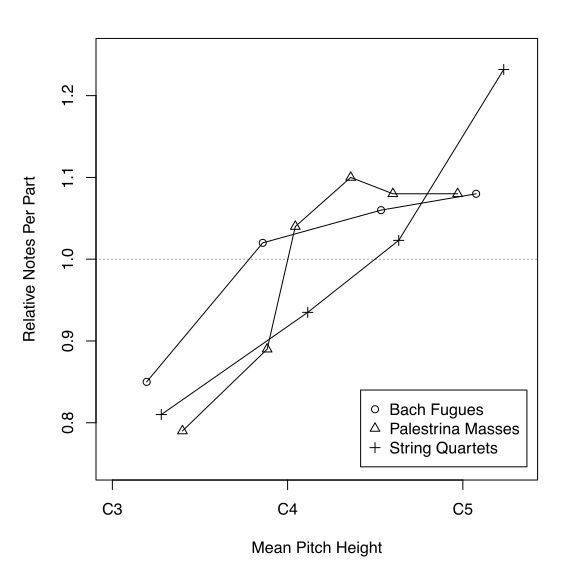
Table 2 reports tessituras (i.e., average pitch heights), note tallies, ratios of note distribution, and statistical results for the Bach fugues, Palestrina mass movements, and string quartet movements. For all three samples, higher voices tend to have more notes. This pattern is consistent with the hypothesis that higher voices show more activity than do lower voices. Chi-squared tests for significance were performed between each adjacent pair of voices.4 With eleven comparisons, we took marginal tests to be statistically significant when their p-values were below .05/11 = .004. All pairwise comparisons exhibited statistical significance except for three: the Soprano/Alto pairing in the Bach Fugues, and the Cantus 1 / Cantus 2 and Cantus 2 / Altus pairings in the Palestrina Masses. Based on these results, one would conclude that higher musical parts do indeed show more note activity.
A visual representation of these data is given in Figure 3, where each corpus’ distribution of notes across parts is plotted against each part’s tessitura. All three genres of music display some form of the hypothesized pitch-speed relationship. For the Bach fugues and Palestrina masses, the greatest differences in musical activity appear to involve the lowest voices, whereas the top voices display reasonable parity. By contrast, the string quartets have significantly more musical activity in the top voice than any other. That is, the pattern of partwise pitch-speed association appears to differ qualitatively between the string quartets and the other two samples.
If pitch-speed effects are mediated by actual pitch height as well as by a part’s ordinal position in a musical texture, then one would expect that musical voices spread across a large range of pitches should exhibit greater differences in speed than those with more similar tessituras. To test the effect of tessitural “spread” on the relative activity of the outer voices, we employed Pearson’s correlation r. The Bach fugues (r(35) = .110, p = 0.52) and string quartets (r(98) = .087, p = 0.39) showed no detectable effect, while the Palestrina masses showed somewhat higher linear dependence (r(99) = .196, p = .05). While all three correlations were positive, none reached statistical significance. Hence, it would appear that speed depends more on ordinal position in a texture than on absolute pitch height.
Discussion
From these results, one could conclude that organization of music into parts does predict regularities in note distribution. In particular, lower parts seem to be considerably less active than higher parts, with the lowest part typically being least active. This organizational pattern appears to relate directly to the ordinal position of the voices in a texture instead of the actual pitch height of the musical parts. Part-based organization of music might thus be a more important determinant of compositional choices than pitch height per se. It seems reasonable that listeners might learn to comprehend music in the same way.
While relative partwise activity might be perceptually salient, one could still object that the note-tallying measurement method does not necessarily reflect high musical speed: a string quartet movement in which the cello has bursts of rapid playing intermixed with long and frequent multimeasure rests could also result in a low note count. To address this possible confound, we repeated the partwise study using only those measures in which all musical voices participate, and compared them to the original results. This post hoc rest-eliminating method produced similar results overall, but with somewhat reduced effect sizes. The complete sample results (representing net musical activity) and the rest-eliminating results (representing typical contribution to four-voice textures) had an average samplewise correlation of .821. We interpret this to indicate that while multimeasure rests do account for a measurable portion of partwise activity differences, there remains a substantial effect attributable to musical speed differences.
In this approach, musical “part” was defined and tested in such a way as to allow contributions from several sources of variance apart from simple ordinal position in a musical texture. For example, the observed difference in activity between string quartet cello and viola parts might reflect their different instrumentation or their different musical purposes: cellos often perform basslines and violas often perform accompaniment figures. Similarly, the difference between the first and second violin parts could reflect the tendency for melodies to appear in the top musical voice. In all, the data are consistent with the presence of partwise pitch-speed effects, even if the precise causes remain to be fully explored.
Study 3: Effect of Instrumentation
The first “notewise” study indicated that western music of some styles exhibits a systematic relationship in which higher notes are shorter; the second “partwise” study similarly suggests that higher musical parts display more musical activity. Study three focuses specifically on the question of whether instrumentation might play a role in mediating these effects, testing the hypothesis that lower-pitched instruments generally exhibit slower musical speeds. In pursuit of evidence converging with that of score-based methods, actual performed musical speeds were measured for several common western instruments using a sample of recorded performances.
The pitch-speed hypothesis suggests that low-pitched instruments typically perform slower music than high-pitched instruments. Based on the results of the second study, one might reasonably expect that instrumental effects in ensemble music would be difficult to distinguish from effects due either to the ordinal position of a part, or its typical melodic, harmonic, or supportive role. In an effort to treat each instrument as equitably as possible, we studied instrumental performance in the context of instrumental solo repertoire. In such music, a single featured instrument typically performs the primary melodic content of the piece, while other musicians provide supportive accompaniment. Because music played by featured soloists would presumably be subject to different compositional constraints than more typical ensemble music, this repertoire could provide a perspective on pitch-speed relationships complementary to those of the notewise and partwise studies. Specifically, we reasoned that solo repertoire should be less likely to reflect the compositional determinants of typical part-based ensemble writing, and more likely to reflect what is idiomatic to the instrument itself.
Methods
Sixteen common monophonic orchestral instruments representing string, brass, and woodwind families were identified (Table 3). For each, the nominal highest and lowest sounding pitches are listed as reported in Samuel Adler’s The Study of Orchestration, 3rd Edition (Adler, 2002). The midrange pitch was used to characterize the instrument’s tessitura.5
In order to assemble a representative sample of solo literature, we used the Naxos Music Library’s website for access to recordings (Naxos). Naxos is a major record label known for its extensive catalogue of recorded western art music. At the time of this study, the catalogue was reported to contain 880,711 individual tracks. A sample of solo recordings for each target instrument was assembled by using the search string “[instrument name] recital.” We selected the first four albums returned by the search for each of the 16 target instruments, which were typically collections of works for solo instrument, usually with piano accompaniment, sometimes with guitar or harp, and occasionally with a larger instrumental ensemble.
From each album, we randomly selected three tracks, subject to certain constraints. If any track appeared to have two or more soloists, or was a recording of a piece already sampled, it was discarded. For the euphonium and piccolo, four albums could not be identified, so the twelve tracks were drawn from only three unique albums. Similarly, the bass trombone proved to be an uncommon instrument in recital recordings; six tracks each were selected from the two available albums.
For each track, the soloist’s initial speed was measured in notes per second by counting the number of notes played in the first 10 seconds following the soloist’s entry. Trills were counted as multiple notes. For each instrument, speeds were calculated for each of the twelve tracks, and the median speed was taken to represent an instrument’s probable melodic speed.
| Instrument | Range | Midrange (from C4) | Median Speed (notes/sec) |
|---|---|---|---|
| Strings | |||
| Violin | G4–B7 | 25.5 | 2.60 |
| Viola | C3–A6 | 10.5 | 1.55 |
| Cello | C2–E6 | 2.0 | 2.55 |
| Double Bass | C1–G4 | −14.5 | 1.70 |
| Woodwinds | |||
| Piccolo | D5–C8 | 31.0 | 3.35 |
| Flute | C4–D7 | 19.0 | 2.00 |
| Oboe | B♭3–A6 | 15.5 | 3.10 |
| Clarinet (A) | C♯3–F♯6 | 9.5 | 3.05 |
| Alto Saxophone | D♭3–B♭5 | 5.5 | 2.40 |
| Bassoon | B♭1–E♭5 | −5.5 | 1.95 |
| Brass | |||
| Trumpet (C) | F♯3–C6 | 9.0 | 2.55 |
| Tenor Trombone | E2–F5 | −1.5 | 2.20 |
| Horn | B1–F5 | −4.0 | 1.60 |
| Bass Trombone | B♭1–B♭4 | −8.0 | 1.65 |
| Euphonium | G♭1–B♭4 | −10 | 1.40 |
| Tuba | B0–G4 | −15 | 1.20 |
Instruments and ranges adapted from Adler (2002, Appendix A). Range is as reported for professional-caliber orchestras. Midrange indicates the note whose pitch lies in the middle of the range, measured in semitones from middle C (C4). Speeds are measured in notes per second for the first 10 seconds of recital recordings.
Results
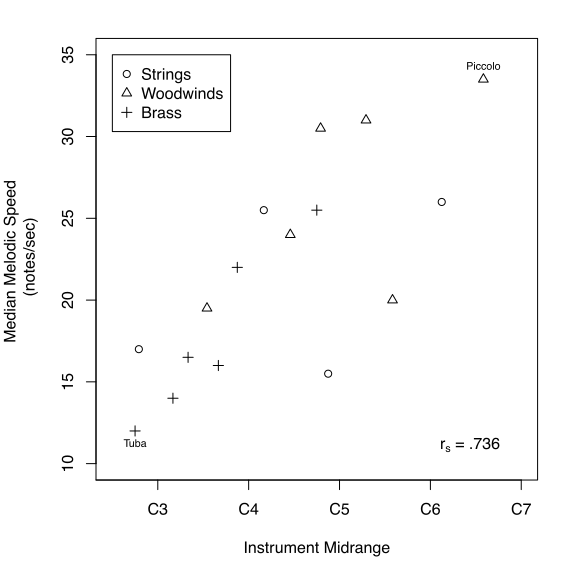
Spearman’s rank correlation rs was used to measure the relationship between median melodic speed and instrumental tessitura. The correlation between instrumental midrange and median melodic speed was quite high (rs = .736, p < .002), consistent with the hypothesis that high-range instruments tend to play faster than instruments with low range. Figure 4 summarizes this relationship graphically, showing a clear positive association between instrumental tessitura and typical musical speed. For example, the piccolo exhibits both the highest midrange pitch and the fastest melodic speed, whereas the tuba exhibits the lowest midrange pitch and the slowest speed.
It would seem that even when instruments are performing with the same nominal musical role—that of featured soloist—musical pitch-speed relationships appear. Because these results depend on sound recordings instead of computerized scores, the instrumental pitch-speed relationship identified here presumably reflects some combination of compositional decisions and performance practices. Further experimental work could elucidate the relationship between composer and performer choice, perhaps by asking several performers to perform music without tempo indications, or asking several composers to write music appropriate for different instruments.
Study 4: Trills and Ornaments
While carrying out the third study using instrumental recordings, it became clear that a great deal of rapid melodic activity is associated with ornaments such as trills. Inspired by this observation, we carried out a brief fourth study to examine the distribution of melodic ornaments in relation to different pitch levels.
Melodic ornaments include trills, mordants, turns, and other such musical embellishment figures that typically involve rapid sequences of pitches. Ornaments are often abbreviated using purpose-specific symbols placed above a given note in a score. The presence of an ornament therefore indicates a sequence of notes more rapid than the surrounding music. If a pitch-speed effect is present, one might expect higher musical parts to exhibit more ornaments than lower musical parts. Our test of this hypothesis focuses on Baroque music, where ornaments are a relatively common feature.
Accordingly, we used a convenience sample of fifteen two-part inventions and fifteen three-part sinfoniae by J. S. Bach, predicting that there would be more ornaments in the upper part of the two-part inventions and in the highest of the three parts in the sinfoniae. Results are given in Table 4. Substantially more ornaments were notated in the uppermost voice, a result consistent with the pitch-speed hypothesis. In all, we identified 150 soprano-voice ornaments and only 61 bass-voice ornaments, a statistically significant difference (χ²(1, N = 211) = 37.5, p < .001).
| Bach Inventions (2 parts, 15 Inventions) | |
|---|---|
| Part | Ornaments |
| Soprano | 123 |
| Bass | 58 |
| Part | Ornaments |
|---|---|
| Soprano | 27 |
| Alto | 19 |
| Bass | 3 |
Distribution of notated ornaments in J. S. Bach’s Inventions and Sinfoniae. The occurrence of these rapid trills and mordants is more frequent in the highest musical voice (χ²(1, N = 211) = 37.5, p < .001).
General Discussion
In all, our results are consistent with the idea that high musical speeds and high musical pitch tend to coincide in compositional and performance practice. Moreover, this correspondence seems to be instantiated in many different ways. In summary, the first “notewise” study found that low notes tend to be longer in certain styles. The second “partwise” study suggested that the distribution of musical activity favors parts with higher ordinal positions in the texture. Our third study directly measured instrumental performance speeds in notes per second, finding that typical performance speeds are highly correlated with typical instrumental tessituras. Finally, a fourth study indicated that fast-paced melodic ornaments tend to occur in the uppermost voice. Although pitch-speed interaction effects might bias one’s perception of musical speeds, the intuitive notion that higher music is faster appears to be largely substantiated.
Musical Speed and Musical Line
Our first “notewise” correlational study indicated a musical pitch-speed relationship for some of the genres studied, but not all. On one hand, the hypothesized association might simply be absent in these subsamples. An alternate interpretation would posit that the hypothesized relationship does exist, but the notewise operationalization of musical speed is too crude to detect it in some musical styles. To help determine which account is correct, it would be useful to directly compare the performance of the notewise and partwise measurements when used on the same musical sample.
In a post hoc test, the notewise method of the first study was applied to the pieces sampled for the second study. For each score, pitch-duration correlations were calculated. The string quartets exhibited 7 positive correlations and 93 negative correlations—a striking imbalance consistent with the pitch-speed hypothesis, and in agreement with the second study’s results. The Palestrina masses exhibited 30 positive and 71 negative correlations. While less pronounced, these results are also concordant with the second study’s result. However, applying the notewise method to the Bach fugues produced null results, with 18 positive and 19 negative correlations. These results stand in contrast to the partwise results of the second study, which identified statistically significant results for the fugue’s three lower voices.
Therefore, it seems that the first study’s notewise method might not have captured all types of pitch-speed organization: pitch-speed relationships in musical practice might depend more directly upon the activity of musical parts than upon isolated notes. Another way of saying this is that pitch-speed relationships become most obvious when tones are organized into melodic “lines.” This is intuitively sensible from a perceptual point of view—after all, things which seem to have any speed at all must first somehow be perceived as being “objects.” Indeed, the process through which listeners identify musical lines as independent auditory streams has been well-studied (see, e.g., Miller, 1950; Dowling, 1973; van Noorden, 1975; Bregman, 1990). In short, it seems that notes don’t have speed, but lines do.
Five Theoretical Accounts
Here, we offer several preliminary accounts for compositional pitch-speed organization, roughly organized into five categories: acoustic, kinesiologic, music theoretic, sensory, and perceptual/psychological. These explanations are not intended to be exhaustive, but to provide a basis for future work.
Acoustic. Perhaps the pitch-speed relationship originates in the physics of sound production on musical instruments, which in turn could influence compositional and performance practice. For example, informal observation suggests that larger, lower-pitched instruments tend to have longer initial attack transients before notes reach full amplitude. It is possible that such limitations would restrict a low-pitched instrument’s ability to play music effectively at rapid speeds.6 A straightforward investigation of acoustic limitations on performance speeds could test whether otherwise identical music tends to be performed more rapidly on instruments with shorter onset times.7 However, while acoustic explanations are attractive, it seems unlikely that they could be solely responsible for the particular pitch-speed relationships observed in the present investigation.
Kinesiologic. Pitch-speed relationships might arise from the human movements involved in vocal and instrumental performance. As lower-pitched instruments tend to be larger and heavier, they could place increased demands on a performer’s strength or agility. For instance, valves and fingerboards for large instruments tend to require more strength to operate than those of smaller instruments. It might be physically taxing to rapidly move slides or fingers the distances required in low pitch ranges.
Some musically-relevant motor limitations might be manifestations of Fitts’s Law, a model of human motion (Fitts, 1954). According to Fitts’s Law, muscular motion is subject to a tradeoff between simultaneous speed and accuracy: fast movements are unlikely to be very precise, especially when distances are long. Interestingly, melodic behavior does appear to be consistent with Fitts’s Law (Huron, 2001), although it remains to be seen whether this reflects motor constraints or perceptual ones. In general, it would seem that kinesiologically derived pitch-speed effects should become most evident when performing very challenging music. A direct test for physiological effects on musical speed might endeavor to develop a complete picture of the muscle movements involved in instrumental or vocal performance, and experimentally quantify the effects of each.
Music Theoretic. A music scholar might point to the particular history of western music’s development as giving rise to the observed relationship. An association between speed and pitch height would naturally result from the compositional practices of twelfth century Aquitainian vocal polyphony, in which faster voices were composed atop extant chant melodies (Yudkin, 1989). Music theoretic reasons also apply to homophonic compositions: here, bass notes might tend to exhibit less embellishment than other voices due to their privileged status in western music, resulting in an overall slower speed. Cross-cultural studies could test whether the observed pitch-speed relationship is unique to the western musical tradition, or if it represents a more general pattern.
Sensory. The idiosyncratic design of the auditory system could account for pitch-speed relationships in music in several different ways. One explanation pertains to limitations in pitch perception: as tones become lower in frequency, pitch perception itself becomes increasingly difficult for short tones (Houghty & Garner, 1947; Pollack, 1968; Robinson & Patterson, 1995). Perhaps lower notes tend to be longer in order to accommodate this perceptual limitation.
Another account would note that uppermost voices in polyphonic textures tend to be the most perceptually salient (Huron, 1989). Melodies, which are often faster than accompanying parts, would sensibly be featured by placing them in the highest voice (and perhaps by ornamenting them as well). While the fourth study on ornaments supports this explanation, the partwise study suggests that inter-part differences more frequently involve the lowest lines in a texture.
Perceptual/Psychological. There are two explanations related to the psychology of musical expectation that deserve discussion. The first is based on perceptual pitch-speed interaction effects of the sort described by Collier and Hubbard (2001) and Boltz (2011). The existence of these interactions indicates that listeners use information from multiple perceptual domains to determine the most likely speed of music, which could be particularly helpful if information in one or another modality is noisy or unreliable. Based on pitch-speed interactions, one would expect the piccolo obbligato in Stars and Stripes Forever to sound subjectively faster when played on a piccolo than if it were played several octaves lower on a tuba. However, the existence of interaction effects cannot immediately explain why composers would choose to amplify the perceptual effect by writing music in which lower pitches move slower yet. One possibility would be that composers tend to write music following whatever pitch-speed correspondences they usually perceive. If this is true, then any musical tradition ought to slowly drift toward more pronounced pitch-speed relationships, as long as the perceptual effect persists.
Speed judgments might also be affected in a different way: one could argue that listeners should make speed judgments relative to context-dependent expectations. If listeners expect higher music to be faster in general, then shouldn’t they tend to evaluate higher music against this adjusted baseline? Surprisingly, this “expectation calibration” argument appears to make a prediction directly opposite to that of interaction effects. In this view, a tuba performance of the Stars and Stripes obbligato would probably seem impressively fast by tuba standards, even if it were objectively slower than typical piccolo speeds. This argument is particularly attractive in that there are many ways composers and performers could exploit context-dependent musical expectations (see, e.g., Huron, 2006; Meyer, 1956).
Although the predicted effects of “perceptual interaction” and “expectation calibration” might appear contradictory, the two are not in fact mutually exclusive. One could interpret pitch-speed interactions as representing a strategy to maximize the chance of making a correct judgment (or producing an accurate percept) within a given contextual frame. For example, a collection of stimuli used in a perceptual experiment would implicitly define the contextual frame within which speed judgments are to be made. By contrast, the “expectation calibration” argument would apply when a listener is in the process of choosing an appropriate contextual frame, such as when they watch a tubist walking onto the stage. An experiment testing for the latter effect could not use a set of predetermined stimuli, but would instead need to measure speed judgments within listener-defined contexts.
Put another way, pitch-speed interactions might be most useful to determine what happened, and expectation calibration most useful to predict what is likely to happen next.
Future Directions
Given the diversity of plausible causes for pitch-speed correspondences, there is reason to suppose that a complex network of interactions might underlie the observed relationship. For example, small perceptual effects may favor certain musical practices, which are then amplified by cultural norms. Testing for a perceptual effect may therefore lead one to erroneously believe that the proximal cause is perceptual, when in fact the effect is primarily a consequence of cultural inertia. Ultimately, progress may depend on the development of causal models rather than testing single-cause conjectures.
Footnotes
One could also point out that the piccolo part covers a wider span of pitch space (an eleventh) than does the tuba (a fourth). Spatial metaphors for pitch height imply that a one-second melody which traverses a large pitch interval would be perceived as ‘faster’ than one which traverses a smaller interval in the same amount of time (c.f. Boltz, 1998). In the present study we restrict our discussion of musical speed to the temporal dimension. ↩
Correlations fall between −1.0 and 1.0; average correlations were calculated under Fisher’s z transformation (Fisher, 1921; Silver & Dunlap, 1987). ↩
An earlier version of this study gave slightly different results due to three differences in the analytical methodology. In the present work, (1) notes in instrumental transpositions have been restored to concert pitch, (2) double-stops, split spines, and chords have been incorporated, and (3) sustain pedal markings in piano scores have been expanded (c.f. Broze & Huron, 2012). ↩
The chi-squared test is here used as a large-sample approximation to the binomial test. ↩
In the case of string instruments (violin, viola, cello, double bass), this midrange pitch and the observed mean pitch heights from Study 2 have a Pearson correlation of r = .997, indicating that the calculated midrange bears a strong relation to an instrument’s practical tessitura. ↩
There is evidence that such instrumental attack transients are of a musically meaningful duration. For example, Pickering (1986) found that on some strings, violins can take up to 300 ms or more before attaining a steady tone, corresponding to a common-time eighth note at 100 bpm. ↩
We thank an anonymous reviewer for this suggestion. ↩